
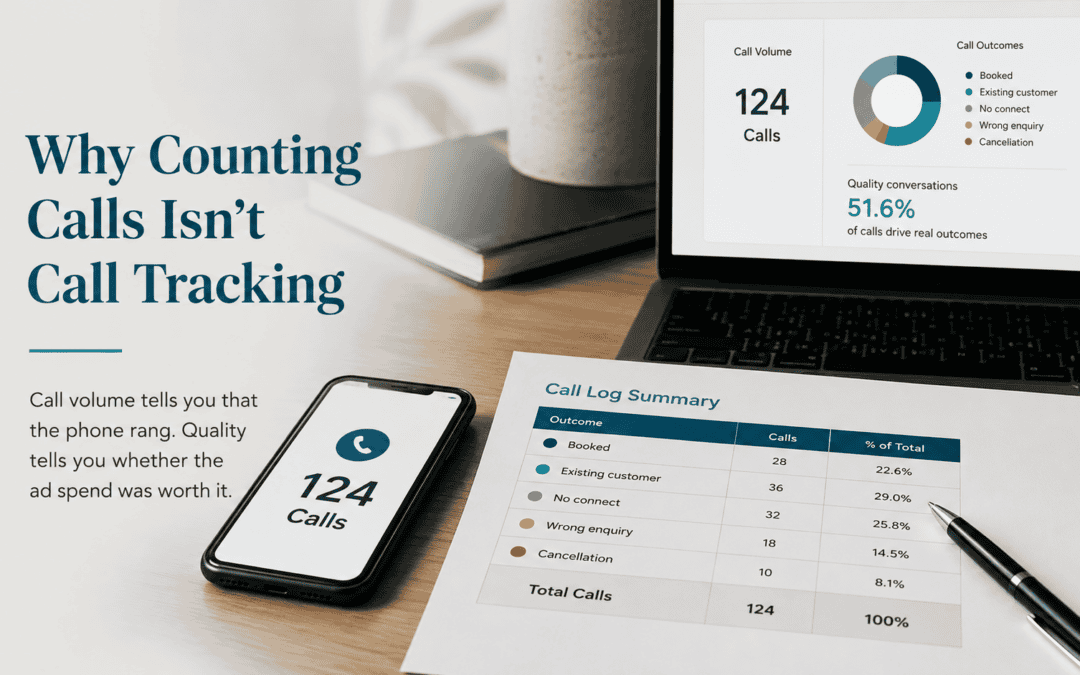
Why Counting Calls Isn’t Call Tracking (And What It’s Costing You)
Short answer: Recording that a call happened tells you almost nothing. What matters for paid ads is recording what kind of call it was, then feeding that quality signal back to Google (or Bing, or Meta) so the algorithm can learn what a genuinely good lead looks like. Without that feedback loop, you keep paying for the same low-quality calls on repeat.
The problem with “we track our calls”
Most businesses running Google Ads or Meta Ads have some form of call tracking switched on. A dynamic number, a call recording, a monthly total in a dashboard. It feels like enough.
It isn’t.
A call count answers “did the phone ring?” It doesn’t answer “was that call worth the money we spent to generate it?” Those are very different questions, and only one of them tells you whether your ad spend is working.
What a real call log shows you
We recently went through eighteen months of a client’s phone enquiry log, line by line, looking specifically at calls attributed to paid ads. The same handful of patterns kept showing up:
● Calls that never connect. Voicemail prompts, disconnected lines, “maximum call limit reached.” One number rang to voicemail six separate times before it was ever answered – six paid clicks, zero conversations.
● Enquiries the business can’t serve. Repeated calls asking about a service the business explicitly doesn’t offer (in this case, NHS appointments at a private practice), every time ending the same way: “no, we don’t do that.”
● Price objections with no recovery path. Calls where the cost was discussed, the caller went quiet, and nothing was done to capture or requalify that lead.
● Existing customers, not new business. A meaningful share of “conversions” were existing patients calling about an order status or a reschedule – people who already knew the business and would have called regardless of the ad.
● Cancellations. Some paid-ad-attributed calls were literally someone cancelling. A negative outcome, counted as a positive by a dashboard that only measures call volume.
None of this is visible if the only metric being tracked is “number of calls.” All five of those patterns show up as a “conversion” on a basic call-tracking setup, and all five are, to varying degrees, wasted spend.
Why this matters more than it used to
Google Ads (and most modern ad platforms) now lean heavily on automated bidding that optimises toward whatever you tell it counts as a conversion. If “a call happened” is the signal you’re feeding it, the algorithm will happily go and find you more voicemails, more wrong numbers, more people asking about services you don’t provide, because as far as it knows, those are wins.
This is the part that gets skipped most often: the algorithm can only optimise for the quality signal it’s given. If every call counts the same, it can’t tell a booked appointment from a disconnected line, and it has no reason to stop spending on the traffic that produces the latter.
Turning call tracking into something useful
The fix isn’t more tracking. It’s better classification, fed back into the platform:
1. Listen to (or read transcripts of) the calls, not just count them.
2. Tag each call by outcome – booked, existing customer, price objection, disqualified enquiry, no-connect – using categories specific to the business.
3. Import only the genuine conversions back into Google Ads as the conversion action driving bidding, rather than “any call over X seconds.”
4. Feed disqualifying patterns into negative keywords – if “NHS” keeps generating calls a private practice can’t help, exclude it at the search-term level.
5. Review the log regularly, not just the dashboard summary. The patterns above weren’t visible in a monthly report. They only showed up when someone read the notes column line by line.
The takeaway
If you’re spending on paid ads and the only thing you’re reviewing is a click count and a call count, you’re very likely missing where the money is leaking. It’s rarely in one obvious place. It’s in the repeated “voicemail,” “wrong number,” and “do you do NHS” entries that never get flagged as a problem because nobody’s classifying the calls – they’re just counting them.
Call tracking that doesn’t feed quality data back to your ad platform isn’t really call tracking. It’s a call counter, and it will happily let you keep paying for the same mistakes indefinitely.
Sandra Chapman is the founder of All Aspect Media, a Google Partner-certified agency managing over £23m in ad spend for clients across the UK. If you want a second pair of eyes on what your ad spend is converting to, get in touch.
Recent Comments