
Google’s 17 August Bidding Change: What Every Target CPA and Target ROAS Advertiser Needs to Check
Short answer: From 17 August, budget limited Target CPA and Target ROAS campaigns will stop beating their targets and start chasing the exact number you’ve entered in settings. If your campaigns have been outperforming their targets because they were limited by budget, that outperformance is about to disappear unless you review your targets, your budgets, and the maths behind both before the change lands.
What’s changing
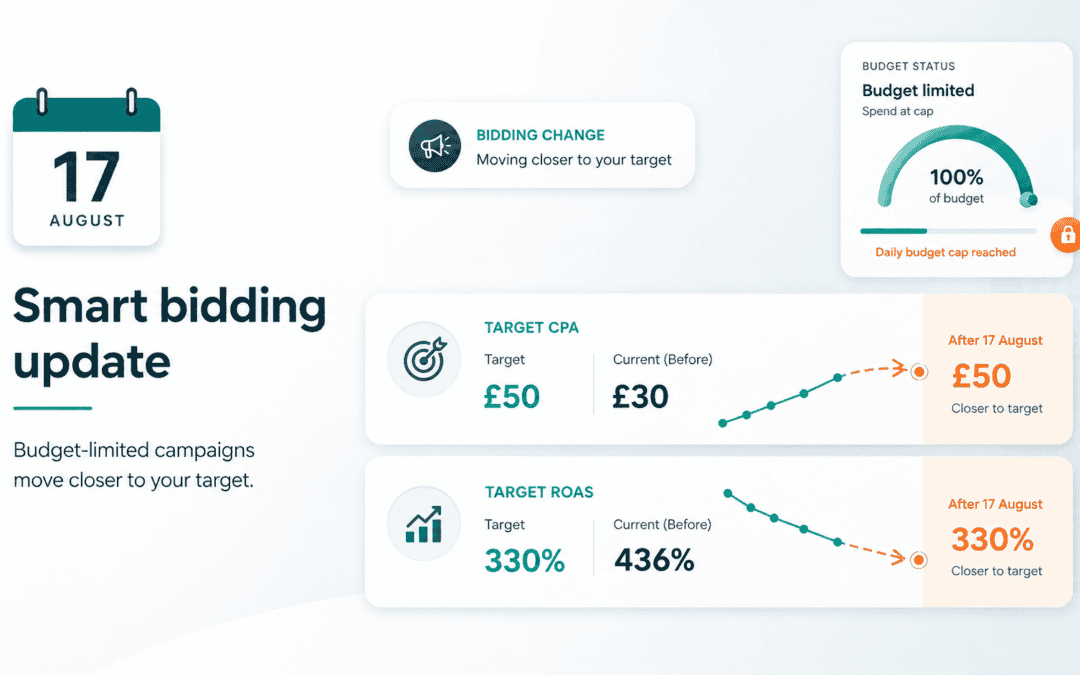
Take a campaign with a target CPA of £50. Over the past few months it’s been generating conversions for £30. Right now, if that campaign is limited by budget, Google concentrates the available spend on the cheapest conversion opportunities it can find. So although the target says £50, the campaign keeps delivering conversions for substantially less.
After 17 August, that stops. Google says these campaigns will start working more closely towards the target you’ve entered. That’s good for stability and predictability, but it also means a £30 CPA will slowly drift up towards £50.
The same applies to Target ROAS. In one live account, a PMax campaign has a target ROAS of 330% but is currently achieving 436%, generating £4.36 in revenue for every pound spent. Leave that target at 330% and, from 17 August, Google will start trying to get results closer to 330% instead, which means real money left on the table if nothing changes.
Why budget limited campaigns currently outperform their targets
When a campaign is restricted by daily budget, Google has to decide how to spend that limited amount, and it tends to prioritise auctions likely to produce the cheapest conversions and strongest returns. In that situation, your target CPA or target ROAS behaves more like a ceiling than the number Google is trying to hit.
Imagine a £50 target CPA and a £100 daily budget. If Google can currently find conversions at £25 each, that £100 buys four conversions. After the change, Google may be willing to enter more expensive auctions and spend closer to the full £50 CPA with that same £100 budget, which could mean two conversions instead of four.
Cheaper conversions aren’t automatically better ones, they can be lower quality leads or thinner margin sales. But when the budget is fixed, letting Google spend more per conversion reduces the total number of conversions that budget can buy.
What happens if you increase the budget instead
If you’re genuinely comfortable paying £50 per conversion and you remove the budget restriction, Google can enter more auctions while still aiming for that same £50 target. Instead of £100 buying two conversions, £200 might buy four. There are two separate questions here: how efficient do your campaigns need to be, and how much you’re willing and able to spend at that level of efficiency. The problem only shows up when the target itself isn’t genuinely affordable for the business.
Don’t just copy the last 30 days
A common piece of advice is to look at your recent CPA or ROAS and set your target to match it. That can be reasonable, but not automatically. The last 30 days might include a seasonal spike, a promotion, a bank holiday, a strong product launch, or a temporary dip in competition. Review a meaningful period, understand what drove the results, and for lower volume lead generation accounts consider 60 or 90 days instead of 30.
If, after ruling out those external factors, you’re genuinely happy with the results, move the target gradually rather than all at once. Jumping a target ROAS from 330% straight to 436% risks confusing the algorithm. A staged approach, for example 330% to 370%, a week’s review, then to 400%, then further, gives Smart Bidding time to adjust.
Doing the maths on your own target
For Target CPA, work out what you can genuinely afford per conversion: the percentage of leads that become customers, average customer value, gross profit per customer, fulfilment costs, and how much profit you’re prepared to reinvest in acquiring the next one. As an example, if one in five leads becomes a customer and the average gross profit per customer is £500, each lead is worth roughly £100 in gross profit before other costs, a useful starting point rather than a final number.
For Target ROAS, the same logic applies to margin. A 300% ROAS, £3 revenue for every £1 spent, might be highly profitable for a high margin business and far less so for a retailer with thin margins, high delivery costs, or frequent returns. Your ideal target should reflect gross margin, cost of goods, fulfilment, transaction charges, returns, and marketing costs, not just the highest number on the dashboard.
Which campaigns to review first
- Any campaign on Target CPA or Target ROAS that is currently limited by budget, or spending close enough to its budget that it could tip into that position without warning.
- Campaigns that look safe today. A campaign can move into budget limited status at any point as demand, competition, or your own settings shift.
What to do right now
- Identify every campaign running Target CPA or Target ROAS.
- Check which of those are currently limited by budget.
- For each one, note the target in settings, the actual recent CPA or ROAS, the daily budget, and the quality of the conversions behind the numbers.
- Ask whether your conversion tracking is feeding Google accurate values. If tracking is out, every decision built on it is out too.
- Decide, for each campaign, whether to increase budget, adjust the target gradually, or both.
The wider market impact
This change reaches beyond any single account. Picture ten businesses competing for the same keyword, all with a £50 target CPA but historically paying £30 because their campaigns are budget limited. If none of them act, Google raises auction prices for all ten until it meets that £50 target, so everyone ends up paying more, and because everyone is still budget limited, everyone’s conversion volume drops too. Google advertising gets more expensive across the board, which is exactly why understanding your own numbers matters more than ever right now.
Sandra Chapman is the founder of All Aspect Media, a Google Partner certified agency managing over £23m in ad spend for clients across the UK. If you want your accounts checked against the 17 August change before it lands, get in touch.

Recent Comments