

How AI Is Changing the Way Customers Find Businesses Online
For years, being found online followed a fairly familiar pattern.
Someone typed a few words into Google, scanned the results, clicked through to several websites and decided which business looked right for them.
That journey has not disappeared, but it is becoming far less predictable.
People can now ask Google, ChatGPT and other AI tools detailed questions, describe exactly what they need and receive a summarised response or shortlist of options. Instead of searching for “accountant near me”, someone might ask:
Which local accountant would be suitable for a small ecommerce business that needs help with VAT and wants regular advice rather than just year-end accounts?
The technology does more than match a few keywords. It attempts to understand the full request, gather information from multiple sources, compare the available options and present an answer.
This is changing how businesses are discovered and what your online presence needs to do before a potential customer ever reaches your website.
Search is becoming a conversation
Traditional searches tend to be short. AI-assisted searches can be longer, more specific and followed by further questions.
A customer researching a new kitchen, for example, might begin by asking about the likely cost. They could then narrow the search by location, style, timescale, materials and whether the company manages the installation. The whole research process can take place as a conversation rather than a succession of separate searches.
Google describes its AI search features as particularly useful for nuanced questions, comparisons and queries that previously required several searches. Its systems may break one question into a number of related searches before bringing the information together into a response.
The important change for businesses is this: you are no longer trying only to appear for a keyword. You are also trying to become a credible part of the answer.
Your website may not be the first place someone encounters your business
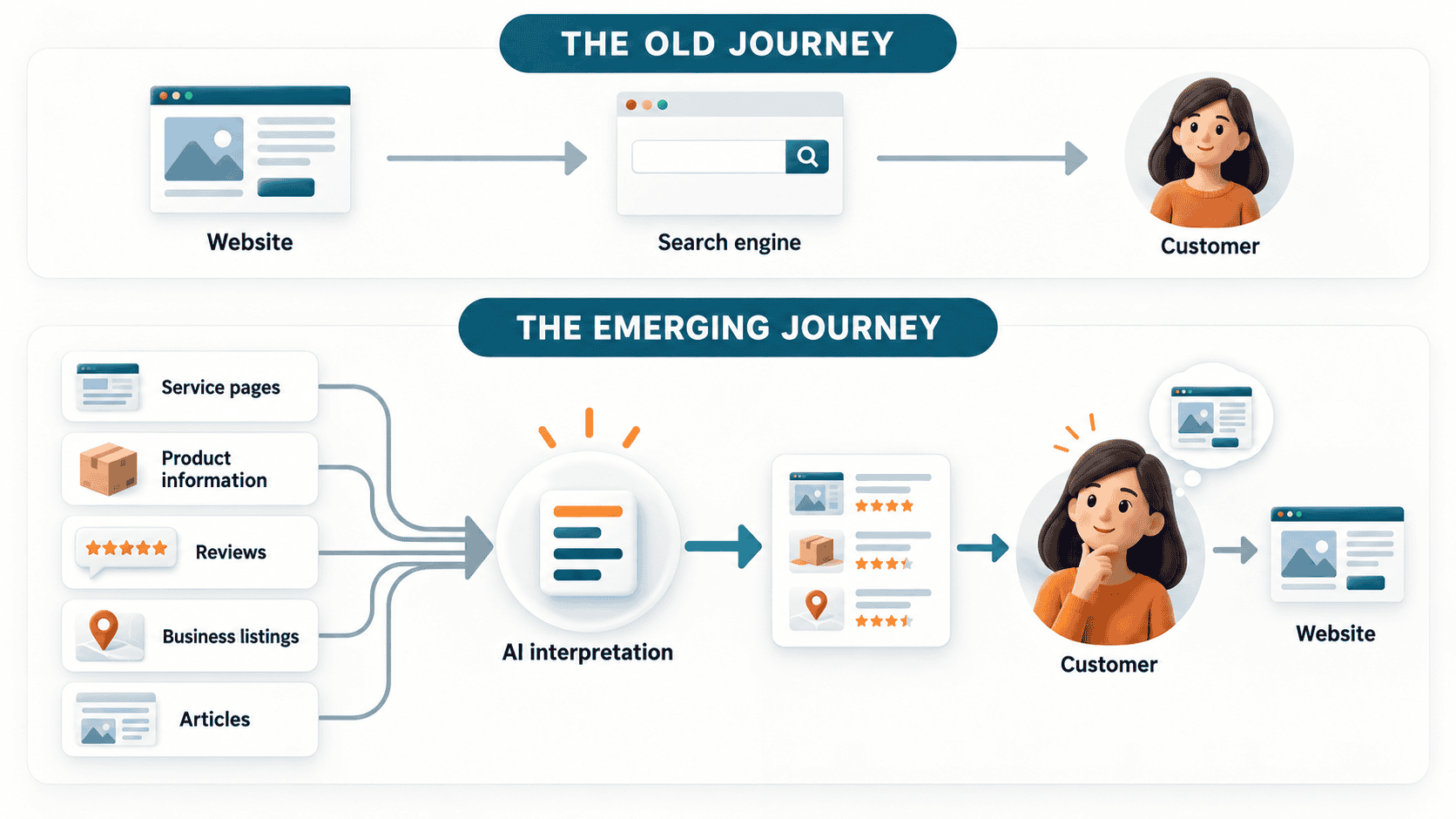
The old journey was often described as:
Website → search engine → customer
The emerging journey may look more like:
Website and other online sources → AI interpretation → customer
An AI-generated response may draw on your service pages, product information, reviews, business listings, articles and other reliable references to your company. It may summarise that information before the person decides whether to visit your website.
That means a potential customer could form an impression of your business without seeing your homepage, carefully designed navigation or main sales message.
This makes the quality and consistency of the information available about your business increasingly important.
Does this mean traditional SEO is dead?
No. The foundations of search visibility still matter.
Google’s own guidance says that its established SEO best practices remain relevant to AI Overviews and AI Mode. A website still needs to be accessible to search engines, technically sound, easy to navigate and filled with useful, reliable, people-first content.
There is no special piece of “AI schema” that guarantees inclusion in an AI-generated answer. Nor is adding an llms.txt file a shortcut to visibility across AI platforms.
What is changing is the type of information businesses need to provide.
A page designed around one broad keyword may have been enough to attract a traditional search visit. To be useful within a more detailed AI-assisted journey, it may also need to answer the questions that help a customer judge suitability.
What does AI need to understand about your business?

Imagine asking an informed person to recommend your company. Before they could do that confidently, they would need to know:
-
What you actually provide
-
Who your services or products are suitable for
-
Where you operate
-
What makes your approach different
-
What your process involves
-
What things typically cost
-
What experience or evidence supports your claims
-
What customers should expect next
If this information is missing, vague or spread across disconnected places, it becomes harder for customers, and AI systems, to understand when your business is a relevant choice.
Statements such as “we deliver outstanding solutions tailored to your needs” say very little. Specific information is far more useful.
For example, a pool company that clearly explains the areas it covers, the types of pools it installs, typical project stages, planning considerations, maintenance requirements and realistic budget ranges provides far more substance than one relying on a gallery and a short contact form.
The same principle applies whether you are a solicitor, retailer, tradesperson, consultant, clinic, venue or hospitality business.
Seven practical ways to prepare for AI-assisted search
1. Answer the questions customers genuinely ask
Speak to the people who answer your phones, handle enquiries or manage sales. What do prospective customers want to know before they are comfortable taking the next step?
Turn those questions into useful website content. Some answers may belong on your main service pages; others might justify guides, comparison articles or FAQs.
Do not write questions purely because a keyword tool shows search volume. Start with the questions that influence real buying decisions.
2. Make your services specific
Avoid making customers work out whether you can help them.
Explain who each service is for, what it includes, where it is available and what the process involves. If there are situations where it is not suitable, saying so can make the page more trustworthy and help attract better-qualified enquiries.
3. Strengthen the evidence behind your claims
Anyone can claim to be experienced, trusted or high quality. Show the evidence.
Useful evidence might include:
-
Detailed case studies
-
Named qualifications and accreditations
-
Original photographs
-
Customer reviews
-
Clear author information
-
Examples of completed work
-
Realistic explanations of outcomes and limitations
The aim is not to add badges for decoration. It is to give both customers and search systems reasons to trust the information you publish.
4. Keep your business information consistent
Check that your business name, location, service areas, contact details and opening hours agree across your website, Google Business Profile and important directories.
For ecommerce businesses, product names, prices, availability and specifications should also be accurate and consistent across the website and product feeds.
Conflicting information creates doubt at exactly the point when a customer, or an AI system, is trying to establish facts.
5. Publish information that adds something
Producing large volumes of generic AI-written content is not an AI-search strategy.
The strongest content contains knowledge that could only come from genuine experience: the mistakes customers make, the trade-offs involved, the questions people forget to ask and the details that affect the final decision.
AI can help structure or refine that knowledge, but it cannot replace the expertise the business needs to contribute.
6. Make important information available as text
Videos, images and downloadable brochures can all be valuable, but do not hide essential information inside them.
Key details should also appear clearly in the text of the relevant webpage. Pages should be logically structured, internally linked and easy for both people and search engines to understand.
Structured data can help search engines interpret certain types of content, but it should accurately reflect what visitors can see on the page.
7. Measure business outcomes, not just website traffic
AI-generated answers may change when and why people click through to a website. Some simple questions may be answered before a visit happens, while people who do click may arrive with a clearer idea of what they need.
This makes traffic alone an increasingly incomplete measure of marketing performance.
Track meaningful actions such as calls, enquiries, bookings, purchases and qualified leads. Where possible, connect those actions to actual sales and revenue.
The goal is not to attract the largest possible number of visits. It is to help the right people discover, trust and choose your business.

You do not need to optimise for every new acronym
SEO, AEO, GEO, LLMO and AI SEO are all used to describe aspects of visibility within traditional and AI-driven search.
Businesses do not need five disconnected strategies.
They need a strong, accessible website; clear and accurate information; genuine expertise; consistent business data; and content that helps customers make decisions. Those foundations support visibility whether the journey begins with a conventional Google search, an AI Overview, AI Mode or a question asked through another AI platform.
The labels will continue to change. The underlying requirement is much more stable: make your business easy to understand, easy to trust and easy to choose.
The businesses that prepare now will have an advantage
AI is not replacing search with one entirely new system overnight. Traditional results, maps, review sites, social media, advertising and recommendations will continue to influence customers.
But the journey between a person recognising a need and choosing a business is becoming more fragmented. AI is increasingly present in the research and comparison stages, interpreting information before the customer reaches you.
Businesses that provide clear, useful and verifiable information give themselves more opportunities to be found during that journey.
Those relying on thin service pages, vague claims and outdated business information may find that the problem is no longer simply where they rank. It is whether search and AI systems understand enough about them to include them in the conversation at all.
Frequently asked questions
How is AI changing online search?
AI allows people to ask longer, more detailed questions and receive summarised answers, comparisons and recommendations. Search is becoming more conversational, with customers able to refine what they want through follow-up questions.
o next.
Can my business appear in AI-generated search results?
Can my business appear in AI-generated search results?
Potentially. AI search features can use publicly available web content and link to supporting websites. Clear, reliable and accessible information can improve a business’s eligibility to be understood and surfaced, although no platform guarantees inclusion.
Do I need a separate AI SEO strategy
Not necessarily. Good technical SEO, useful people-first content, consistent business information and clear evidence of expertise remain essential. AI search increases the importance of answering detailed customer questions and making your business easy to understand.
Is traditional Google search disappearing?
No. Traditional search results remain important, but they now sit alongside AI Overviews, conversational search features, maps, shopping results, advertising and other discovery channels.
What should a small business do first?
Review its main service or product pages from a customer’s perspective. Check whether they clearly explain what is offered, who it is for, where it is available, why the business is credible and what the customer should do next.
Meet the Author

Sandra Chapman
Google Ads Partner, Director
Sandra Chapman is a digital marketing specialist and Director of All Aspect Media Ltd. She has managed more than £23 million in advertising spend across the UK and international markets. Her work spans Google Ads, website strategy, conversion tracking and emerging AI tools, with a focus on helping businesses understand how changes in technology affect the way customers discover, evaluate and choose them.
Learn more about Sandra and All Aspect Media
This article contains my own analysis and recommendations, informed by Google’s published guidance on AI Overviews and AI Mode, alongside my experience working across paid search, websites, analytics and customer journeys. AI-assisted search is continuing to develop, and no particular placement or inclusion within an AI-generated response can be guaranteed.
If you’re unsure whether your website clearly communicates what your business offers, or whether search engines and AI platforms can understand it, I can help you identify the gaps.
Recent Comments