

Why the message is the multiplier
Two businesses can spend identical budgets on identical keywords and see dramatically different results.
Every pound you spend on Google Ads buys you one thing: the opportunity for someone to read your ad. Whether they click, whether they convert and whether they become a customer is determined almost entirely by the message — what you say, how you say it, and whether it matches where that person is in their decision-making process. This is why two businesses can spend identical budgets on identical keywords and see dramatically different results. It is rarely the targeting. It is almost always the message.

The buying stage problem. Not everyone searching the same keyword is at the same point in their decision. Someone searching "accountant for small business" might be in early research mode, comparing options, or ready to pick up the phone today. These are three completely different conversations, and an ad that only speaks to one of them will either waste clicks from the others or fail to convert the ones who were ready.

Awareness stage
They know they have a problem but are not yet sure what the solution looks like. They are researching, comparing and learning.

Consideration stage
They understand their options and are evaluating providers. They want reasons to choose: credibility, proof and differentiation.

Decision stage
They've made up their mind on the solution and are choosing between providers. They need clarity, urgency and a low-friction next step.
Most Google Ads treat every searcher the same way, with the same headline, the same CTA and the same landing page. The checklist that follows is designed to help you identify where your messaging is creating unnecessary friction, where it is failing to match what the searcher actually needs to hear, and where stronger, more specific language could make a meaningful difference to the results you are already paying for.
The single strongest signal that an ad is relevant is that it reflects the language and intent of the search that triggered it. Google calls this message match, and it affects not only whether someone clicks your ad, but how much you pay for that click.

Message match goes deeper than repeating a keyword in the headline. It means understanding what the searcher is actually looking for, the problem they are trying to solve, the outcome they want, and speaking directly to that.
What to look for
Pull up your search term report and look at the three most common searches triggering each ad group. Then read your headline. Would a person who typed that search feel like your ad was written for them specifically, or would it feel like a generic response?
For the buying stage question, look at whether your campaigns separate high-intent searches such as buy, near me, cost of and hire from research-stage searches such as how to, what is and best way to. If they are all going to the same ad with the same message, the early-stage searcher is seeing a CTA they are not ready for, and the decision-stage searcher is not getting the urgency and specificity they need.
The fix is not always more keywords. Often it is better ad group organisation, grouping searches by intent and writing a more specific ad for each group. Fewer, tighter ad groups with more relevant messages consistently outperform broad ad groups with generic headlines.
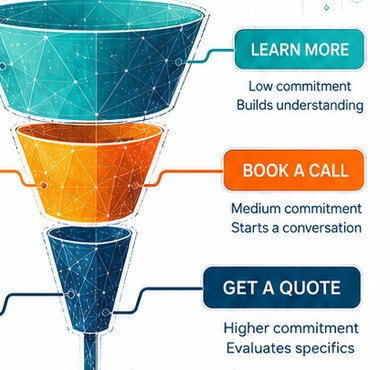
The call to action in a Google Ad is not just a button label. It signals what happens next, and whether that next step feels like a natural progression or an uncomfortable leap.
A person in the awareness stage does not want to be asked to buy now. A person in the decision stage does not want to learn more — they want to know exactly how to get started. The CTA also plays a role in qualifying traffic: an ad that says get a free quote will attract different clicks than one that says view pricing. Neither is inherently better; the right one depends on who you want clicking and what the next step in your sales process actually looks like.
What to look for
Look at each of your current CTAs and ask: what is the person being asked to do, and how much commitment does that ask require? Get a Free Quote is relatively low friction. Book a Consultation is higher. Buy Now is highest. The friction level of the CTA should match where the searcher is in their decision.
For qualification, think about whether your CTAs are attracting the right type of enquiry. If you're a premium service provider getting lots of leads from people who baulk at your prices, your CTA might be failing to qualify out the wrong audience. Adding language like for businesses with X or from £X can reduce volume but dramatically improve lead quality.
Google Ads appear in a list. Your potential customer can see your ad, the ad above it and the ad below it in the same glance.

The question they're answering, often subconsciously and in under two seconds, is: which of these looks most likely to solve my problem? Features tell people what a product or service does. Benefits tell them what it does for them, the outcome, the feeling, the problem solved. Proof tells them that it has done it for others.
What to look for
Read your current headlines as if you were the customer. For each one, ask: so what? If the answer is not immediately obvious, the headline is a feature, not a benefit. Same-day service available is a feature. Back to normal by this evening is the benefit of that feature.
For proof, look at whether your campaigns are using review extensions, seller ratings or callout extensions to surface social proof. These can appear without using up headline space and often have a significant effect on click-through rates.
For testing, ask whether you are actively testing whether 10 years' experience outperforms 4.9 stars on Google, or whether a price anchor outperforms a quality claim.

What do we do?
State your core offer clearly.

Why does that matter for you?
Show the outcome, benefit or transformation.

Why us rather than someone else?
Prove credibility, trust and differentiation.
There's a significant difference between testing and tinkering.
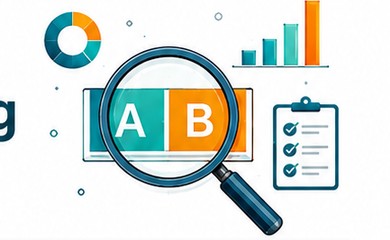
Tinkering is when an ad is changed because it feels stale, because someone had a new idea, or because performance dipped for a week. Testing is when a specific hypothesis is formed, a controlled change is made and the result is measured against a clear metric over a sufficient time period. Most Google Ads accounts tinker. Very few test properly. This matters because without proper testing, you accumulate changes without ever truly knowing what made the difference, which means you cannot repeat it, cannot scale it and cannot use it to inform the next decision.
What to look for
Google's ad strength indicator is designed to encourage you to add more headlines and descriptions. Excellent ad strength does not mean excellent performance — it means you have given Google many options. Use your own performance data, not Google's rating system.
For asset performance, review your RSA assets and look at the performance labels. Anything consistently rated Low should be replaced. But the more valuable question is: of the assets rated Best, why are they winning?
For proper testing, change one variable at a time, one headline, one claim, one value proposition, and leave it long enough to accumulate meaningful data.
Click-through rate is easy to improve and easy to misread.

You can write a sensational headline that earns thousands of clicks from people who have no intention of buying. CTR tells you whether your ad is getting attention. It does not tell you whether that attention is from the right people, or whether it is producing anything useful for your business. The same problem applies to conversion counting. If every form fill, page visit and phone call is treated as an equally valuable conversion, Google's algorithm cannot distinguish between a tyre-kicker and a high-value prospect. It will optimise for volume, not quality.
What to look for
List every conversion action currently being tracked in your account. For each one, ask: does a conversion here represent something commercially meaningful? A phone call that lasted four seconds is probably not a genuine lead. A contact form fill from someone asking about a price point you do not serve is not a qualified enquiry.
For conversion values, consider whether you can assign different values to different types of conversion, a phone call versus a form fill, or a high-value service enquiry versus a general query. Even approximate value assignment helps Google's smart bidding understand which outcomes are worth more.
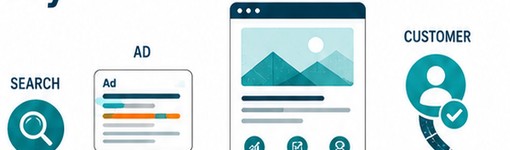
The ad earns the click. Everything that happens after the click determines whether that click becomes a customer.
Yet most Google Ads audits focus almost entirely on the ad itself and ignore the fact that the landing page, the sitelinks and the extensions are all part of the same message. When someone clicks an ad and arrives on a page that does not continue the same conversation, trust breaks immediately. The page might be well-designed. It might even be technically optimised for conversion. But if the headline on the page says something different from the headline in the ad, the searcher's subconscious registers a mismatch.
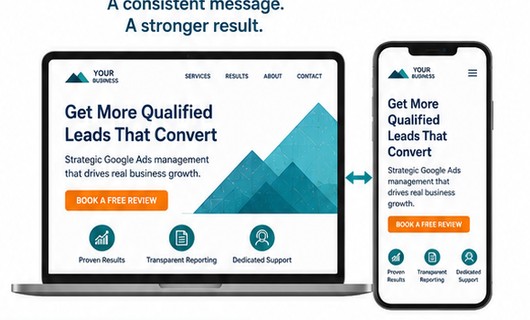
A consistent message. A stronger result.
What to look for
For each of your main ads, click through to the landing page it sends traffic to and read the first thing a visitor sees. Does it feel like a continuation of the ad, or a non-sequitur? The headline on the page should speak to the same intent as the search that started the journey.
For sitelinks, look at what you currently have and ask whether they are helping the right people find the right thing faster. Generic sitelinks like About Us and Contact add very little. Specific sitelinks like See Client Results, View Our Packages or How We Work give the searcher more ways to self-qualify and more reasons to engage with your offer.
What your answers are telling you
As you work through the sections, anything flagged for review updates your result here.
Answer at least one question above to unlock your download.
Get your results
Enter your details and we'll email you a copy — your PDF will also download automatically.

Mostly clear
Your messaging is largely well-considered. The opportunity is in the details — sharper testing, stronger proof points and better conversion signal quality.

Some gaps
There are specific areas where the message isn't aligned with what the searcher needs to hear. These are fixable and will likely have a meaningful impact on conversion rates.

Significant issues
The messaging is working against the account's ability to perform. Addressing it is not a cosmetic improvement, it is a fundamental part of making the budget work properly.

Whichever picture emerged, the next step is the same: decide which of the questions flagged is most likely to be costing you the most right now, and address that one first. Trying to fix twenty things simultaneously is how you end up with an account full of half-finished changes and no clear read on what worked.
Start with the message-to-search-intent match, because everything downstream depends on it. If the ad is not relevant to the search, no amount of CTA optimisation or landing page testing will recover the conversion. Once the message is right, work outward: to the CTA, to the landing page, to the proof points and the testing approach.
 Messaging improvements compound. A 10% improvement in click-through rate + a 10% landing-page lift produces 21% more leads from the same budget. The message is the multiplier.
Need a second opinion?
If any of these questions made you uncomfortable, let's talk.
This checklist shows where problems are likely to be. A Google Ads review goes further: it looks at your account, search terms, ads and landing pages, then shows what is working, what is wasting budget, and what should change first.